Noah B Woodworks

A woodworking page for the free time foot soldier

Hello there! My name is Noah Budd and I am a woodworker from southeast Michigan. I hail from a small set of towns in the Upper Peninsula called Houghton/Hancock. I lived there for 24 of my 31 years, and graduated from Michigan Tech in 2019 in audio production.

In my free time I am a dad first and hobbyist second. I make music, read books, smoke pipes, and kayak fish. I am a broadcast engineer in my professional life, working an early morning 3:30 – 11:30 am shift. The early bird has most definitely gotten a worm or two.

Thanks for stopping by my site and feel free to reach out to me on Instagram @noahbwoodworks or via the email found on the contact page

-Noah

  • This weekend, as I was working in my woodshop happily carving my next tobacco pipe, I made a grave mistake. I got lost in the sauce and carved too deeply into the stem. I carved a hole into it and rendered the thing firewood. Or did I? My first thought wasn’t “I have to start all over” or “It’s destined for the waste bin” No. It was “How do I save it?”

    If you haven’t already, I’d recommend adopting this attitude. Mistakes are bound to happen; it’s in our nature as humans. The question then becomes: how do I handle them? If you do something long enough, a mistake is guaranteed, so it is wise to be prepared for the inevitable. It starts with “How do I save it?” or “How can I hide this?”

    Obviously there are moments that require you start completely from scratch but often the mistakes made are trivial. On a recent table project, the Maple and Brass Bar table found in My Collection of Work, I accidentally used a woodscrew that was compromised and it snapped off three quarters of the way into drilling. This is hard maple we’re talking about so I knew there was no way I was getting it out. So I plugged the hole above the broken screw with more maple, and drilled a new pilot hole very close to the original screw, through the plug. It looked terrible up close but added the fastening strength I needed to secure the board in place. Plus it was on the back of the table, which is where I was hiding a few other mistakes.
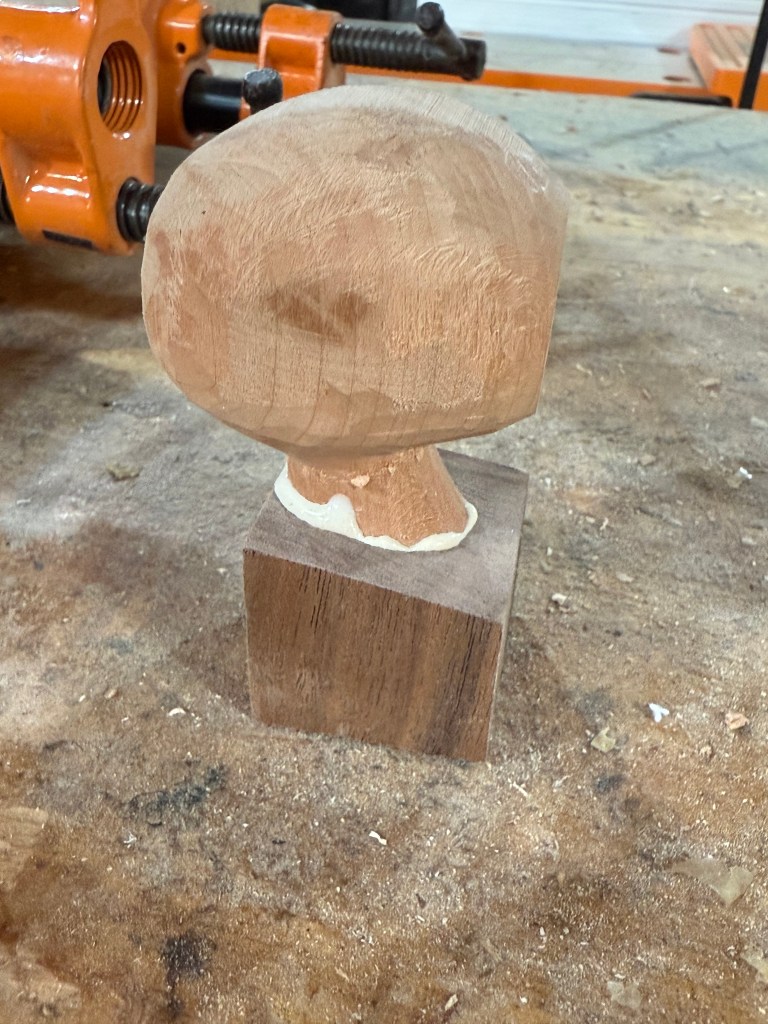
    When I carved through the cherry stem of my most recent tobacco pipe I was devastated. I carved so far was because I was enjoying the shape so much. Foolishly attempting to emphasize the details only to make a fatal mistake at the last minute. I immediately thought “how can I save this?” The answer came to me quickly. Cut the mistake off. So I fashioned my hand saw, fastened the work in the vise and got to cutting. Once the bit with the hole was removed, I cut an angled chunk of black walnut and glued it to the stem. After work today, I am planning to shape the walnut and finalize the pipe.

    By the time I’m done with the pipe it will look completely different than the one I first imagined. Originally one piece of cherry wood, now with a walnut accent. It is curious how such a terrible mistake could actually benefit the piece, making it more visually interesting than what I had originally set out to make.

  • One of the worst habits a person can have is leaving work unfinished. It is a habit that plagues many, and plagued me for a long while. I recognized the importance of ‘finish what you start’ when I naively took on a colossal project at the age of 16. I set out to restore my dad’s 1983 F-250. I had grand, romantic plans to build a custom hardwood bed, interior and rebuild its powerful engine. I quickly ran out of money and motivation for the project, being 16 and all, and it sits unfinished to this day. I think about it all the time, and at some point in my life, perhaps when it slows down, I’d like to return to it. This experience taught me the importance of choosing my projects wisely.

    To finish a project, you need a few things: A solid, achievable design, a plan for how to realize it, and the patience to finish it when you don’t want to. It’s that last part that I see friends and family struggle with. It is safe to assume that the last 80-90 percent of any big project will be an absolute slog. After weeks or months of working on the same thing, there is no doubt you will be tempted to move onto something new. Don’t. You’ll thank yourself when you push through and receive the satisfaction of realization.

    You must keep strictly to this golden rule and make it a new standard. Make it a habit and soon it wont be a problem. Smaller projects are easier to finish and often as satisfying. I recently carved a tobacco pipe by drilling a few holes and shaped the exterior with a sloyd knife. I purchased the mouthpiece on amazon for 12 dollars and bang! It was done in a few days. With satisfaction, I witnessed the Osmo oil bring the wood to life and moved on to the next.

    If this is something you struggle with, and this problem happens with any art in any medium, I recommend you think about what it means to finish something. For me, it’s easier to finish a woodworking project than a musical one. With music, there is always something to tweak or improve, in an endless cycle of adjustment. It’s difficult to finish anything music, probably because it is an emotional endeavor. Intimate in nature; I’ve always struggled to show it to the world. I find it much easier to complete my woodworking, because I can visually see when it is done. If I take any more wood away, there wont be any wood left. It also depends on your own ego. What is good enough for you? An important question to ask oneself. I’ve slapped many a finish on a one-day project and called it good ’nuff. Use your own discretion, and I’d never recommend you do this for any paying clients project, if you’re so fortunate to have one.

    The next recommendation is for those who have a mountain of unfinished projects littering their livelihoods and occupying valuable space. Start with the smallest one and see it through. Work your way up by size and exercise the muscle of completion. DON’T start anything new, discipline yourself to never break this golden rule. You simply cannot get distracted until the mountain becomes a hill and the hill becomes a mound and the mound becomes something you can hold in your hand. Only then can you begin again with fresh mind and eyes.

    It’s easy to feel intimidated, but with a little practice and strategic approach, it can be just as easy to feel the peaceful relief of achievement. Does the thing do what I need it to do? Does it look like shit? Does anyone care? Does unfinished and rustic-looking fit my style? There are a million objective questions with a million subjective answers in regard to this topic. What does finished look like to you?

  • I am a father of a three-year-old daughter, Naomi and husband to Jamie. We are a proud, multicultural household in Farmington Hills, MI. My dad is a carpenter and handyman extraordinaire who had a dream of restoring mining houses in Michigan’s Keweenaw Peninsula, where I am from. I frequented his woodshop and learned how to woodwork at age 10. In college, I used my woodworking and engineering skills to build an electric guitar and a set of high fidelity speakers. Today, I have acquired a powerful woodworking shop and tool collection in my backyard barn. I can not wait to pass down my passion for woodworking to my daughter as my father did for me.

    Family, function, tradition, and sometimes modern technology all serve as inspiration for my woodworking designs. If it were not for my father teaching me how to use his tools, I wouldn’t have learned how satisfying it is to make a long shaving with a traditional sharp hand plane. Now that I have my woodshop, I have discovered my preferences. I love to build functional pieces of wooden art that look beautiful and serve a long-lasting purpose. In addition, I love to make furniture that embodies more than one function. My educational background is in audio technology, so I constructed a TV stand that features an integrated high-fidelity sound system.  This marriage of form and function really excites me about the future projects that may enter my woodshop.

    If you can dream it, I can make it a reality.