Noah B Woodworks

A woodworking page for the free time foot soldier

Hello there! My name is Noah Budd and I am a woodworker from southeast Michigan. I hail from a small set of towns in the Upper Peninsula called Houghton/Hancock. I lived there for 24 of my 31 years, and graduated from Michigan Tech in 2019 in audio production.

In my free time I am a dad first and hobbyist second. I make music, read books, smoke pipes, and kayak fish. I am a broadcast engineer in my professional life, working an early morning 3:30 – 11:30 am shift. The early bird has most definitely gotten a worm or two.

Thanks for stopping by my site and feel free to reach out to me on Instagram @noahbwoodworks or via the email found on the contact page

-Noah

  • I have always struggled to do the same thing over and over. I realized late in life that becoming a jack of all trades, master of none is actually somewhat of a nightmare. I am endlessly curious and tend to get distracted by activities that look interesting for a couple of weeks or months and then I’ll move on to the next shiny thing that comes into view. Once I realized this was a problem for me, I didn’t fix it. I don’t know if ever I will. Some of the beauty of what I do is in its versatility. I am never working on the same thing, and often, if the project is big, it will push the boundaries of what I’m capable of. This is a positive, but also a negative. I’m not mastering the making of the same exact table/chair/pipe/box in the same exact style. I’m making a bunch of objects that are wildly different.

    I am probably being a bit too literal here. It’s not important that I make the same thing the same way every time I make something, but the process, commitment and style which matter. Finding a repeatable process that guarantees the same quality object, that is uniquely different from the last, but holds strong value. That is what I’m after. I recently got into pipe making and it is todays shiny object for me. Pipes are a good example here, regardless of how long I stick making them.

    A pipe is a pipe, it is a hollow tube which holds tobacco (or other leaf) and you draw through it. Simple as they are, a pipe will work if you accomplish the above, so it has inherent value. They’re small and simple; they don’t take a ton of commitment to finish. They vary endlessly, making their creation interesting. The major road blocks I’ve had in the past with pipes have been solved. I am unable to fashion a good looking mouthpiece, so I purchase from Amazon. I was unable to drill accurate holes, but now I have a drill press.

    I’ve ironed out the process, so now comes the fun part. Shaping and finishing them to be unique and beautiful. I can carve a myriad of different lines, shapes and styles. Embellish the design however I please. But I’ll always start with a blank and a mouthpiece, draw the rough shape, drill the holes, cut, sand closer, carve closer still, and finish to make the wood look beautiful.

    I’ve been inspired in the past (and present) by Christopher Schwarz and his Lost Art Press. If you’re reading this, please investigate his work. His writing is of incredible literary quality, and his educational resources are fantastic. In his early career he was making everything from tables and benches to researching the origins of ancient workbenches. However, in recent years, he has settled into the rhythm of chairmaking. He has ironed out the sturdiest of processes and replicates many a variation on his chair. He writes books and teaches classes in his Kentucky studio. His process is what I’d like to highlight here. He makes the same object, a chair, by using the same repeatable steps, varies the shape, style and dimensions of its pieces and finishes it tastefully. I hope to find the commitment in my own life to hone a process as stable as his.

    I’d like to note that the object in question, a chair, like the pipe, has inherent value. Can you sit in it? Why, then it is quite useful. Now the only pertinent question is, how does it look? According to Chris, who has thought a lot about chairs, you should be invited to sit. It is not just a chair, but a place to ponder; to better oneself. That is not verbatim; I am embellishing his words, but you get the idea.

    I am not a machine made for repeating, but the key idea here is to become a human one. Make the same thing over and over again. You achieve mastery. If the object you make has inherent value, then, with repetition, you will get better at making it. In an almost linear fashion, the object will become more desirable as you bestow it with its ability to invite you in.

  • Does spending more time and energy make the work more valuable? Depends on what you’re creating. Spending time on work that nobody wants is not time well spent, unless you aren’t planning to sell the work. In todays day, there are plenty of precision tools that speed up the mundane tasks such as jointing and thicknessing. These tools make work more efficient and precise, however it cheapens the experience for the creator. My lunchbox planer is one of my favorite tools but feeding boards into it is quite boring.

    Do the machines that make woodworking quicker remove the soul from the craft? Milling a board manually with hand planes leaves an exquisite texture on the wood, especially if not smoothed with a no. 4. Old furniture has this texture that screams into the room “I was handmade!”. Not to mention, hand planing with a sharp, well tuned plane is a fantastic experience and good exercise. If you’re experienced, you do not sacrifice a whole lot of time as compared to the faster, modern methods of milling. However, getting experienced takes a lot of time. Learning to sharpen, true and thickness by hand can be a frustrating and tedious process.

    Last year, around this time, I purchased a very nice CNC machine. It was not cheap, but not industrial. Pro-sumer grade. These machines take precision, quickness and repeatability to the next level. I can’t help but think that everything that comes off the machine is rather lifeless. I’ve made some things I’m really happy with: Whiskey smokers, wood trays, and some other miscellaneous trinkets that I’ve made specifically for my own needs. The CNC comes with its limitations. For example, you can’t carve the underside of a ledge, and it is recommended for the average user to use average bits: Quarter inch end mill, miscellaneous vbits, etc. I have been working to innovate with my machine, which is quite capable. Use it to carve something useful, such as a lidded box, and then inlay that box into a piece of wood I can shape or carve in a unique; soulful way.

    The Shaper Origin router is a really great compromise, expensive as it is. It is a CNC router that you can hold in your hand that uses an external grid, almost like a QR code, to know where it is in space. It feels like woodworking, not manufacturing. You can clamp, rout, unclamp, move, then rout again. It is like using a tool to shape something special rather than making 15 semi-special things in one go on the CNC bed. I don’t own one, so I’m sure it has its limitations and annoying tendencies.

    If you work slowly, and put more of yourself into the work it will always feel better, no matter who the owner of the work is in the end. In todays day though, working slowly feels like you’re falling behind. Taking 15 minutes to thickness a board by hand makes less sense when the job can be done in 3 minutes. Efficiency vs soulfulness. I attempt to find balance. Often, it is much easier said than done.

  • One of the main reasons I started this daily blog was to simply get into the habit of writing my thoughts down. It is a personal archive but also an exercise in discipline. I am absolutely not feeling like writing today but I saw something last week that motivated me to make small changes in my life. Psychologically, talking about your dreams gives you the satisfaction of achieving them. The people who discipline themselves to practice routinely end up actually achieving their dreams. The people who talk about their dreams without action give themselves the satisfaction of achieving the dream without actually doing anything.

    I have made this mistake so unbelievably often in my life. All throughout my 20’s I was talking about how I wanted to make it big in the music industry and making excuses for why I couldn’t work on achievement. It is an easy cycle to fall into if you’re not aware of the repercussions. I fell into the habit of making plans with no thought of how to execute them. Your dreams can make you weaker instead of lifting you higher. It is a painful truth to realize.

    I tend plan so much that I even scheme for what to do when I don’t feel like doing anything. I’ll give myself resources and source material to draw inspiration from. I assume that when I don’t feel like doing anything that I’ll be able to inspire anything at all. That is rather naive of me. The real obstacle is not inspiration, but getting started. When motivation is an issue, getting started feels like I am about to climb a vertical wall. Putting one hand in front of the other and lifting myself onto one foot is the real problem. Discipline is the issue, not inspiration.

    I must endure the discomfort of daily practice and put myself into action, instead of sitting idly by as time gets away from me. In the video I watched last week they said “dreams without action quietly waste time. And time once lost, can never be reclaimed.” It is with small, steady actions performed every day that I’ll bring myself closer to my dreams. Train insane or remain the same.

  • In my attempt to improve my own woodworking and further my understanding of the craft, I purchased a set of books published by Lost Art Press in 2016 titled The Woodworker. This unique set of four books sets out to preserve the work of Charles H. Hayward, a premier craftsmen and educator. Over the next few posts I’ll be discussing some key points from these books, and I’m still working my way through the first.

    In an article from the first book, Hayward writes: Marking out is one of those jobs that cannot be skimped. It must be done carefully because the success of the job depends on it (Lost Art Press LLC, 2016). These days, I often mark with a pencil because its fast, easy and abundant. When I was dovetailing, I used to mark with an extra long bladed Veritas marking knife that I got from Lee Valley for $15. It’s an awesome knife and I will be using it more often. I often notice that pencil marks do good enough work but not first-class work, at least by yesterdays standards.

    When I first started woodworking, I learned about what it took to make a reference surface. A reference surface is essential to accurate marking, but how do you create one without a jointer? A few years ago all I had was a cheap Stanley no. 5, some cheap chisels and some winding sticks. I found the cheapest square that Rockler had as well. I was haunted by a set of questions: Is the sole of my cheap Stanley flat? Is the surface I use to sharpen my blade flat? What is flatness? The answers are no no and yes.

    At the time I bought a small piece of float glass which is glass that is cooled on top of a pool of water, which makes it as flat as the waters surface. Its a really good place to start if you’re looking for a cheap reference surface. I found it was too small for the lapping of tools though, so a few years later I splurged on a piece of granite reference stone that had a flatness certification. This piece of paper showed the tolerances at each corner and the center of the block being less than one thousandth of an inch. I used the block to flatten the bottom of my plane bodies, and now I can use those planes with more confidence.

  • This weekend, as I was working in my woodshop happily carving my next tobacco pipe, I made a grave mistake. I got lost in the sauce and carved too deeply into the stem. I carved a hole into it and rendered the thing firewood. Or did I? My first thought wasn’t “I have to start all over” or “It’s destined for the waste bin” No. It was “How do I save it?”

    If you haven’t already, I’d recommend adopting this attitude. Mistakes are bound to happen; it’s in our nature as humans. The question then becomes: how do I handle them? If you do something long enough, a mistake is guaranteed, so it is wise to be prepared for the inevitable. It starts with “How do I save it?” or “How can I hide this?”

    Obviously there are moments that require you start completely from scratch but often the mistakes made are trivial. On a recent table project, the Maple and Brass Bar table found in My Collection of Work, I accidentally used a woodscrew that was compromised and it snapped off three quarters of the way into drilling. This is hard maple we’re talking about so I knew there was no way I was getting it out. So I plugged the hole above the broken screw with more maple, and drilled a new pilot hole very close to the original screw, through the plug. It looked terrible up close but added the fastening strength I needed to secure the board in place. Plus it was on the back of the table, which is where I was hiding a few other mistakes.

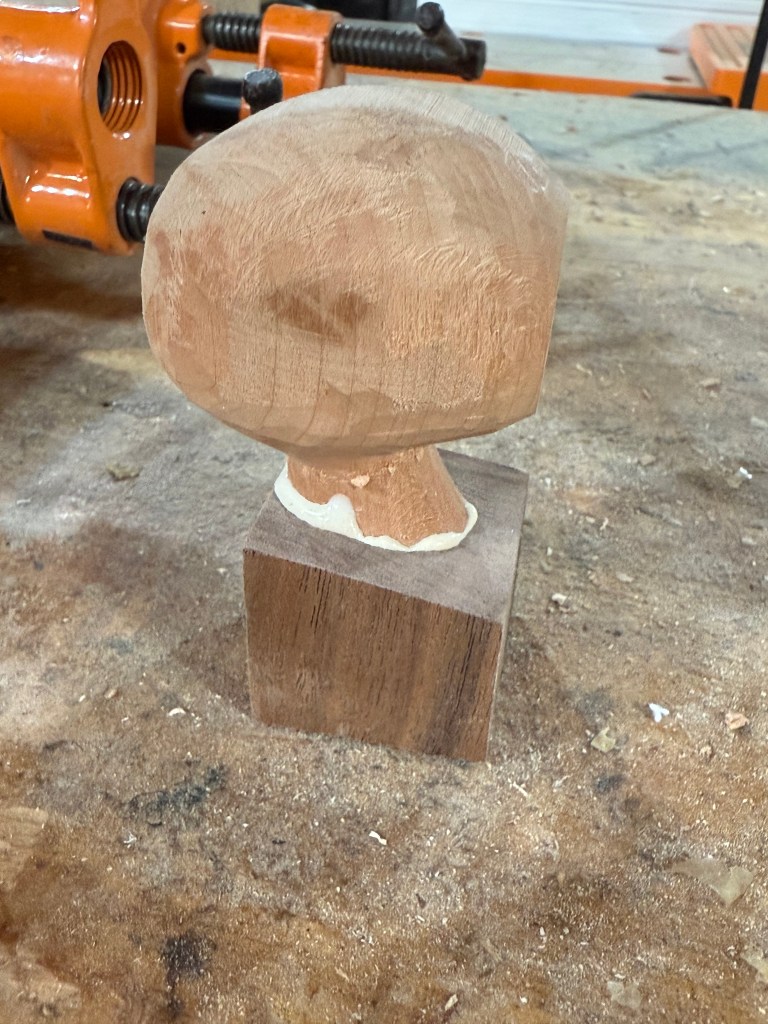
    When I carved through the cherry stem of my most recent tobacco pipe I was devastated. I carved so far was because I was enjoying the shape so much. Foolishly attempting to emphasize the details only to make a fatal mistake at the last minute. I immediately thought “how can I save this?” The answer came to me quickly. Cut the mistake off. So I fashioned my hand saw, fastened the work in the vise and got to cutting. Once the bit with the hole was removed, I cut an angled chunk of black walnut and glued it to the stem. After work today, I am planning to shape the walnut and finalize the pipe.

    By the time I’m done with the pipe it will look completely different than the one I first imagined. Originally one piece of cherry wood, now with a walnut accent. It is curious how such a terrible mistake could actually benefit the piece, making it more visually interesting than what I had originally set out to make.

  • One of the worst habits a person can have is leaving work unfinished. It is a habit that plagues many, and plagued me for a long while. I recognized the importance of ‘finish what you start’ when I naively took on a colossal project at the age of 16. I set out to restore my dad’s 1983 F-250. I had grand, romantic plans to build a custom hardwood bed, interior and rebuild its powerful engine. I quickly ran out of money and motivation for the project, being 16 and all, and it sits unfinished to this day. I think about it all the time, and at some point in my life, perhaps when it slows down, I’d like to return to it. This experience taught me the importance of choosing my projects wisely.

    To finish a project, you need a few things: A solid, achievable design, a plan for how to realize it, and the patience to finish it when you don’t want to. It’s that last part that I see friends and family struggle with. It is safe to assume that the last 80-90 percent of any big project will be an absolute slog. After weeks or months of working on the same thing, there is no doubt you will be tempted to move onto something new. Don’t. You’ll thank yourself when you push through and receive the satisfaction of realization.

    You must keep strictly to this golden rule and make it a new standard. Make it a habit and soon it wont be a problem. Smaller projects are easier to finish and often as satisfying. I recently carved a tobacco pipe by drilling a few holes and shaped the exterior with a sloyd knife. I purchased the mouthpiece on amazon for 12 dollars and bang! It was done in a few days. With satisfaction, I witnessed the Osmo oil bring the wood to life and moved on to the next.

    If this is something you struggle with, and this problem happens with any art in any medium, I recommend you think about what it means to finish something. For me, it’s easier to finish a woodworking project than a musical one. With music, there is always something to tweak or improve, in an endless cycle of adjustment. It’s difficult to finish anything music, probably because it is an emotional endeavor. Intimate in nature; I’ve always struggled to show it to the world. I find it much easier to complete my woodworking, because I can visually see when it is done. If I take any more wood away, there wont be any wood left. It also depends on your own ego. What is good enough for you? An important question to ask oneself. I’ve slapped many a finish on a one-day project and called it good ’nuff. Use your own discretion, and I’d never recommend you do this for any paying clients project, if you’re so fortunate to have one.

    The next recommendation is for those who have a mountain of unfinished projects littering their livelihoods and occupying valuable space. Start with the smallest one and see it through. Work your way up by size and exercise the muscle of completion. DON’T start anything new, discipline yourself to never break this golden rule. You simply cannot get distracted until the mountain becomes a hill and the hill becomes a mound and the mound becomes something you can hold in your hand. Only then can you begin again with fresh mind and eyes.

    It’s easy to feel intimidated, but with a little practice and strategic approach, it can be just as easy to feel the peaceful relief of achievement. Does the thing do what I need it to do? Does it look like shit? Does anyone care? Does unfinished and rustic-looking fit my style? There are a million objective questions with a million subjective answers in regard to this topic. What does finished look like to you?

  • I am a father of a three-year-old daughter, Naomi and husband to Jamie. We are a proud, multicultural household in Farmington Hills, MI. My dad is a carpenter and handyman extraordinaire who had a dream of restoring mining houses in Michigan’s Keweenaw Peninsula, where I am from. I frequented his woodshop and learned how to woodwork at age 10. In college, I used my woodworking and engineering skills to build an electric guitar and a set of high fidelity speakers. Today, I have acquired a powerful woodworking shop and tool collection in my backyard barn. I can not wait to pass down my passion for woodworking to my daughter as my father did for me.

    Family, function, tradition, and sometimes modern technology all serve as inspiration for my woodworking designs. If it were not for my father teaching me how to use his tools, I wouldn’t have learned how satisfying it is to make a long shaving with a traditional sharp hand plane. Now that I have my woodshop, I have discovered my preferences. I love to build functional pieces of wooden art that look beautiful and serve a long-lasting purpose. In addition, I love to make furniture that embodies more than one function. My educational background is in audio technology, so I constructed a TV stand that features an integrated high-fidelity sound system.  This marriage of form and function really excites me about the future projects that may enter my woodshop.

    If you can dream it, I can make it a reality.