Noah B Woodworks

A woodworking page for the free time foot soldier

Hello there! My name is Noah Budd and I am a woodworker from southeast Michigan. I hail from a small set of towns in the Upper Peninsula called Houghton/Hancock. I lived there for 24 of my 31 years, and graduated from Michigan Tech in 2019 in audio production.

In my free time I am a dad first and hobbyist second. I make music, read books, smoke pipes, and kayak fish. I am a broadcast engineer in my professional life, working an early morning 3:30 – 11:30 am shift. The early bird has most definitely gotten a worm or two.

Thanks for stopping by my site and feel free to reach out to me on Instagram @noahbwoodworks or via the email found on the contact page

-Noah

  • I folded like a lawn chair and purchased a 3D printer as they went on sale for black Friday. I plan to use the printer in the following ways: to model and test mechanisms for puzzle boxes, to print little toys for my daughter, and to print organizers for my wife and myself. I was playing around with having AI model things for me, and that was somewhat interesting. Basically I could say something like “make me a hammer” and it would spit some code out that I could paste into another program. The program would render what the AI had made, and it was usually whack. I wasn’t able to get anything good out of it, sort of like when an AI draws a picture there’s just something off and wrong about it.

    I did think it was cool that it could model things and iterating through codes was interesting. I might ask it for more ideas at some point. As of yesterday, documented in my last blog post, I’ve been toying around with Fusion 360 and it is a very legitimate program. I can see why so many people use it. For gears and mechanical engineered mechanisms it is really useful. I’ll most likely follow some tutorials on how to model a mechanism, and then try to print that mechanism.

    It is also winter time, and being out in the barn feels somewhat like a chore when it is 15 degrees out. I’ll still go out there at least once a weekend, but I might wait for it to warm up first. My work schedule happens very early in the morning so I’ll inevitably be up early on the weekends. The question is what to do with the time. The 3D printer can fill that early morning time, I can do computer work from the comfort of my home office and test mechanisms to be made out in the shop. Running the CNC can be done from inside as well, I’ve got a camera set up and the work holding is usually very reliable.
  • With the new prospect of designing and building a puzzle box, I’ve realized that my 3D modeling game needs to improve. So far, I’ve done all of my modeling in Sketchup’s free version, but as far as I know, Sketchup free wont let you create moving parts that interact with each other. So yesterday I downloaded Fusion 360 and started to familiarize myself with the interface.

    I really like it, especially after I put it into dark mode. With the help of YouTube academy I modeled a 2 to 1 gear set and made the gears spin each other. The nice thing about Fusion 360 is that it will export files that are compatible with Carveco, which is the software I use to get G-code for the CNC. Carveco is the program of choice that tells my CNC what to do.

    I’m progressing from last post where I detailed my strategy for manufacturing the parts. Now the focus has shifted to designing mechanisms for the puzzle boxes. The complete strategy is: design mechanisms based off well known mechanical engineering strategies for making objects move, create those mechanisms in Fusion 360, export the 2D files for each part, import the compatible files into Carveco, do very shallow and fine v-bit cuts that accurately outline the shape of each part, and finally cut the parts out with a scroll saw. The material will be a home made quarter-inch thick plywood.

  • I’ve been thinking about how to machine smaller parts for puzzle boxes. I would like to be able to make small gears, levers, keys and other miscellaneous parts for mechanisms. There are a ton of laser cut puzzle boxes on the market and to me they tend to look cheap. They work very well, so maybe it’s because I know how they’re made. I just don’t think they’re very nice to look at. The majority of that feeling comes from the cheap sheet goods that they use in conjunction with their laser cutters. At first, to test out my methods, I’ll probably use the small sheet good plywood material that is an eighth to a quarter inch thick.

    I’d like to move towards making my own quarter to three-eighths inch thick plywood by laminating hardwood boards together. This will make my boxes look a lot more professional and I can put a more personal touch on it by making sheet material myself. Once I’ve got good sheet material I can move towards the CNC.

    I had an idea last night to use the CNC to engrave the design onto the surface of the board with a very thin V-cut bit, and then cut the parts out with a scroll saw. I’m looking to avoid purchasing a $1-3000 laser cutter to do this faster. A cheap scroll saw should do the job and only costs around $100. I’ve been struggling to figure out how I’d use my CNC but I figure engraving images is a fantastic use. I can engrave clues and other images onto the parts that I then cut out with the scroll saw. I figure with a little practice, I can get quite accurate with the saw, especially if the blade and material are very thin.

    This will hopefully be a one-two punch. The CNC shows me what I need to cut and I do the cutting at the scroll saw. Once I’ve designed the puzzle – which I’m still working out a method for doing – I’ll make the material then proceed to create the box using the above methods. We’re getting a little closer, last week I was trying to figure out how to cute the materials on the CNC, which would present some serious work holding issues.

  • This weekend I ended up making a rough draft of my table saw sled, which has been long overdue. It’s nothing too special, and I say it’s a rough draft because I’ll more than likely be adding some work holding clamps and length referencing ruler strips to make it easier to use in the future. It’s a neat little design because there are removable fences that I can use with the table saw.

    The entire sled measures 2’x2′ so I put a 2 foot long by 4 inch wide maple strip perpendicular to the MDF sled on the edges. I screwed it in place so it is very sturdy. That was after I had made, glued and screwed the rails that follow the grooves in the table saw. I made a cut down the middle of the sled and I had the skeleton made.

    My table saw is very old, it’s an antique Delta, so when you angle the motor for miters the motor protrudes above the top of the table saw. I didn’t realize this when I made the sled skeleton. I made a removable fence for mitering that brings the fence forward so I can still do 6-12 inch wide mitered boxes but the sled will bump into the motor at the end of the table saw, which is fine. So far I’ve found that I rarely hit the motor while I’m using the saw. I routed a groove in the fence for a small piece of aluminum T-track, and so I made up a little adjustable stop for the fence, which proved to be very useful. The stop folds down on a hinge so I can swing it up and swing it down as needed.

    I drilled 2 holes into the removable fence and the sled itself and used large hand turned nuts to fasten the removable fence square against the sled. It worked pretty well, and I was able to make 3 mitered boxes very quickly yesterday. I’m hoping to use the sled primarily for mitered boxes, but it can do repetitive cross cuts as well which will be useful for the making of end grain cutting boards.

    While figuring out the correct width for the adjustable mitering fence, I made another fence out of white oak that is a little less thick, which gives more room for bigger cuts on the sled. I ended up making this one first, realized it was too thin, and made the mitering fence I have now. I like the adjustability of it and should come in handy, especially if I add extras like hold down clamps and a ruler for easy measurement.

  • Yesterday I went down a huge puzzle box rabbit hole after I was done working. I watched a ton of videos about how to make simple boxes, and people opening more complex boxes. They’re fascinating to me because of the intricacy and complexity. I’m thinking this weekend I’d like to try to make a small box with a secret compartment. It should be a good introduction into the world of puzzle box making and I’ve already drafted an idea for a more complicated puzzle box.

    Puzzle boxes are interesting to me at this point in my life because they’ve got a lot of depth in terms of story and craftsmanship. Many of the boxes I viewed yesterday had a specific story attached to them. Whether it was killing a jaguar with a spear or trying to find lost gold in the wild west, the boxes took you on a journey and that’s what’s fascinating to me right now.

    I’ll most likely start small and research different mechanisms and work primarily on the mechanisms at first. The CNC will be a very useful tool but I’ve got to figure out how best to do small eighth inch or quarter inch sheet material. I’m thinking I do a sacrificial 12″x12″ piece of MDF and plane it down in the planer when it gets all gnarled up. It’s tricky because I’d like to cut all the way through the sheet goods to avoid having to use the band saw and router. Using those tools will add extra time and effort to the projects. The problem with cutting all the way through is that it is hard on the router bits, especially if I’m using double sided tape to fasten the sheet material down.

    I’ll have to experiment with different sheet goods. Quarter inch sheet material might be large enough to use the flush router with. I’d like to be able to do more intricate, smaller parts but the CNC is sort of a large machine, so work holding is definitely a challenge at the moment. I’d prefer not to ruin bits by constantly cutting all the way through the workpiece and into the tape. I could do a CA glue and scotch tape situation, which probably wouldn’t ruin the bits as fast.

  • Over the last day or two, I have been thinking about designing and making a puzzle box. The CNC could be extremely handy for this task. I’ve also been thinking that these blog posts are very helpful to me as a maker. They act as a springboard to get my ideas onto paper, and release a lot of inner thoughts that I have throughout the week. They help me better prepare for the weekend sessions and I’m not constantly looking to purchase new tools and equipment because I’m focusing my energy on projects ahead.

    This next weekend I’ve got some goals to accomplish. I’d like to do a wooden wall hanging art piece that has an inlaid quality. I’m thinking an old nickelodeon inspired piece where it’s the early 2000’s nickelodeon logo made with contrasting pieces of wood. Either that, or the old cartoon network logo would be cool. I was always more of a cartoon network kid but their logo isn’t as cool as nickelodeon’s.

    The other major goal I’ve got for this weekend is to get the mortising machine that I purchased last weekend to work. I just ordered the parts a minute ago so those could take anywhere from a week to 2 months to arrive. Not holding my breath on that one and I’m fairly certain they wont arrive by the weekend, given that it is Thanksgiving/black Friday.

    So that leaves inlaid logo or wall art piece and to explore a puzzle box. These fascinate me because of the intricacy and complexity. I built a stool with a moving extendable set of steps last weekend and the kinetic (moving) aspect of the chair really inspired me to do more projects with parts that move. Box making is a craft in its own. I’ve been trying to create a humidor for a few weeks now and those boxes are extraordinarily special and beautifully crafted.

    I’ll most likely research how to design these puzzle boxes, and look at different latching mechanisms. So far I’ve come across gear latches and magnetic releases. There are tons of methods, which is an exciting rabbit hole to dig into. The combination of these latching mechanisms make these puzzles unique and interesting to craft. Many of the successful ones tell a story as well, which adds depth and complexity to the object.

  • There are still a few things I’d like to try out in the shop. The circle project being a long-standing one. I’d like to do a small test to see what it’s like to CNC inlay wood circles on top of themselves. I also need to finish my lidded humidor project. I need to acquire more mahogany for that project, which entails a trip to Rockler. Going to Rockler is risky business.

    I would also like to create a Jig for cutting miters. I can do them on the table saw now that I’ve removed the stabilizing clamps from the motor. I can do all sorts of angled cuts now, but I’d like to make a miter sled for the table top before I go too crazy. It would be nice to have a sled, and I’m honestly unsure why I haven’t built one yet.

    So in order of importance: Miter sled, lidded humidor, circles on circles. I’m very excited that I can make angled cuts on the table saw now. I feel like a whole new world has been opened up to my woodworking. Last weekend I was able to make a myriad of 5 degree cuts to accomplish that fold out stool from my last blog post. I’m interested to see what that holds for my future.

    I’ve been thinking about puzzle boxes as well. The artisan crafted puzzle chests and boxes are so interesting to me. As a person who fidgets, I’ve always loved hand held puzzles. Recently, the craft of actually making the puzzles has caught my eye. It would be cool to make something like that for my daughter, so she can hide her treasures in a place we won’t ever look.

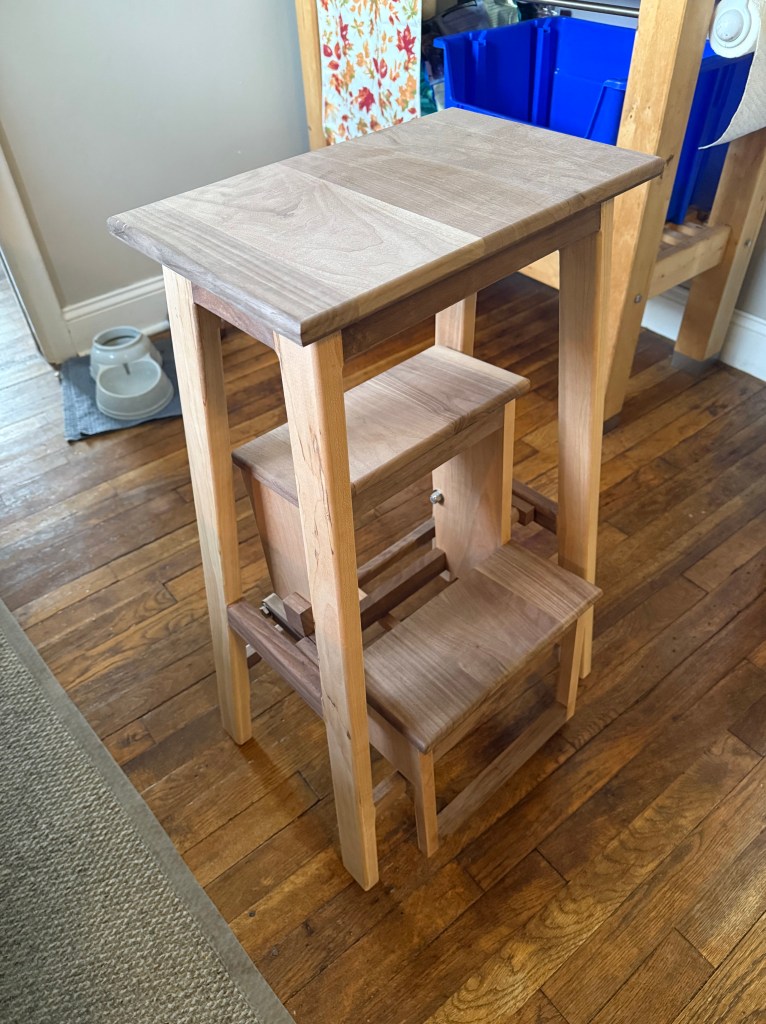
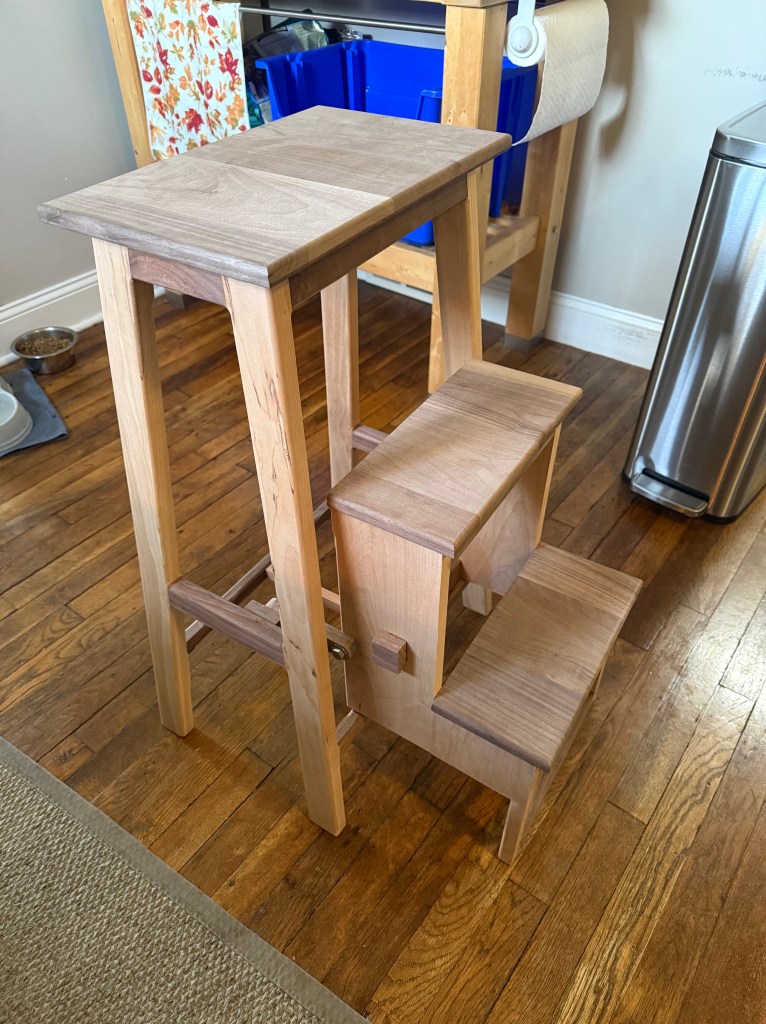
  • Last weekend I was able to finish a protype of a step stool using scrap wood and some cherry. This was quite a challenging little project, because the mechanism for which the steps extend was more complicated than what I normally build. The stool itself is a regular bar stool, with two little steps that fold out beneath the tall seat. The steps are supported by the framing of the stool, and the swing arm is bolted to the stool frame and the sides of the steps.

    The action of the swinging leaves a little to be desired, and is the primary topic of my focus moving forward. If I can sure up the action, so it isn’t sticky or cumbersome to use, I’ll have a winning design. I got pretty lucky this weekend that everything lined up in such a nice way. Moving forward, it would be good to make some of the parts on the CNC.

    I might have unlocked the potential of my table saw too. When I first received my table saw, the motor vibrated a lot, and it sketched me out, so I stabilized it. However, this drastically reduced the functionality of the table saw, making it difficult to do angled cuts. I removed the stabilizing clamps and the saw seemed to work just fine, so they’ll stay off. Angled cuts on the table saw are honestly so crucial if you’re looking to make anything that is more complicated, so I’m feeling good about the status of that tool.

    I’m looking forward to making more of these stools. It would be good to shrink it down a little, the size was just a little too big for my taste. Overall, I’m happy that I was able to build such an ambitious project in such a short amount of time. I used my tools efficiently and accurately despite being tired, which is usually where everything goes wrong and these projects turn into 2 or 3 week long endeavors.

  • I’ve been inspired in the past by the Samurai Carpenter. His woodworking is inspired by Japanese architecture. His work is very clean and soulful. He’s got a mortising machine that he uses for a lot of his joinery. It makes sense that a machine that makes square holes would be very useful in the shop. I was thinking you could use this for all sorts of applications. If needing to fasten two boards together, drill 2 holes and run a squared piece of timber, almost like a bolt, through them and glue it together. Seems like a person could make sturdier objects this way.

    There are quite a few mortising machines on Facebook marketplace for cheap. $200-$300 is a lot to spend on something that can be cut by hand, but the speed and precision might just be worth it. It’s one of those things that I’m not sure how much I’ll use it until I have it. My guess is it is the absolute best for making small shelves and small boxes. To be honest, anything rectangular or square in shape it could be useful for.

    Here I am, convincing myself to buy yet another tool, one I’ve had my eye on for a while. I am utterly hopeless in my attempt to keep my money, but this one might be worth it. Joinery can be tricky at times so if I were to pair the mortising machine with a router I feel like I’d have a fighting chance at making some really cool objects. Then when you add the CNC into the mix for decorative inlays, we might be cooking with gas. Its decided. I’m going to put in a bid on a mortising machine today, and figure out the rest later.

  • This weekend I’ve got a completely blank slate for the first time in a very long time. I have no projects on the horizon, and I’ve got nothing in the woodwork. To be honest I am thinking about going fishing, but it has been quite cold in the mornings – around 30 degrees Fahrenheit. If I do go, it’ll only be for one morning of this coming weekend, so what do I do with the other morning?

    I could clean the shop and sharpen my tools, which would be a good use of time. My shop is fairly clean though, because I gave it a deep clean not too long ago. Some of my tools are quite dull but I always sharpen when I go to use them. I need a small little one day project that I can finish really quickly. Low effort and quick to complete. I was thinking about doing a little box, maybe on the CNC?

    You know, many blog posts ago I talked about the idea to create a hanging wall piece with an inlay. Basically just do a few circles. Inlay a circle, cut a new circle, inlay a contrasting wood circle, and repeat until it looks cool. I might give that a go because it seems fairly low stakes and quick. A morning of experimentation is in my future it seems. I’ll probably start with white oak and attempt to use as much scrap wood as possible. Maybe I can make use of some of my scrap wood too. Make a bunch of cutting boards for Christmas or decorative wall art pieces. My buddy makes Christmas trees for his family, maybe I can take one out of his book and make some band saw reindeer or something.

    I usually have a good idea of what I want to do before I get into the shop, so not knowing drives me crazy. I like to have a plan of attack, so when there isn’t one my wheels start turning. I think I’ve got enough to go off and this should be a good; productive weekend. I am very much looking forward to it.